


Empty inherited properties drain equity at an alarming rate. Every month a house sits vacant, owners lose thousands to mounting bills, accelerating decay, and market opportunity costs. The solution lies in understanding the physics of property deterioration and acting within the critical first 90 days.
Think of an inherited home like a spacecraft left in orbit without maintenance. Just as unattended satellites experience orbital decay, temperature fluctuations, and system failures, vacant properties undergo rapid deterioration. The parallel isn’t coincidental. Both require constant energy input to maintain structural integrity. Both face exponential cost curves when neglected.
The numbers tell a stark story. Vacant homes deteriorate 3-4 times faster than occupied ones, with insurance premiums jumping 50-75% and vandalism risks multiplying by a factor of twelve. Property values can drop 10% within the first six months of vacancy. These aren’t abstract risks. They’re measurable losses compounding daily, much like the way mission planners in space economics calculate the cost of every delay.
The inheritance window creates unique pressure. Probate timelines, family disagreements, and emotional attachment often paralyze decision-making precisely when speed matters most. Meanwhile, pipes freeze, roofs leak, HVAC systems fail, and local housing markets shift. The property becomes a depreciating asset rather than the windfall families expect.
This article examines why velocity beats perfection when managing inherited real estate, drawing unexpected lessons from orbital mechanics and launch windows to illuminate the hidden countdown ticking on every empty home. The key is to sell inherited house fast before deterioration costs spiral out of control.
The Orbital Decay of Value: What Satellites Teach Us About Empty Assets

When a satellite loses its ability to maintain orbit, it doesn’t simply freeze in place. It begins a slow, inexorable descent through the upper atmosphere, losing both altitude and value with each passing day. The same principle applies to inherited properties that sit vacant, every month of inaction accelerates a decline that’s often invisible until the damage becomes expensive to reverse.
In space economics, orbital decay represents a critical threshold where an asset transitions from potentially salvageable to completely worthless. A satellite in degrading orbit might still function perfectly, but its diminishing position makes recovery missions prohibitively expensive. Similarly, an empty inherited house might appear structurally sound on the surface, yet each season of vacancy chips away at its market value through mechanisms most inheritors never consider.
The true cost of an idle asset isn’t what you’re spending to maintain it, it’s the compounding loss of what that asset could have generated if deployed strategically.
This dynamic plays out through three interconnected forces. First, there’s the direct maintenance burden. Just as satellites require periodic station-keeping burns to maintain orbit, vacant properties demand continuous financial inputs, property taxes, insurance premiums, utility connections to prevent pipe freezing, and lawn maintenance to avoid code violations. These aren’t optional expenses; they’re the minimum fuel requirement to prevent immediate catastrophe.
Second comes technological and market obsolescence. A satellite’s sensors and communications equipment become outdated even while it drifts, reducing its eventual resale or repurposing value. Inherited properties face parallel pressures as neighborhood standards evolve, buyer preferences shift toward different layouts or features, and competing listings incorporate modern amenities your vacant property lacks. A home’s value proposition erodes relative to the market even when nothing physically changes.
The third and most insidious factor is opportunity cost. Every dollar spent maintaining a vacant property and every month of potential rental income forfeited represents capital that could have been invested elsewhere, generating compound returns. In aerospace terms, this resembles keeping a functional spacecraft in storage rather than launching a revenue-generating mission, you’re bleeding resources while competitors capture the market you’re monitoring from the sidelines.
The Hidden Costs of Vacant Properties: A Space Mission Budget Perspective
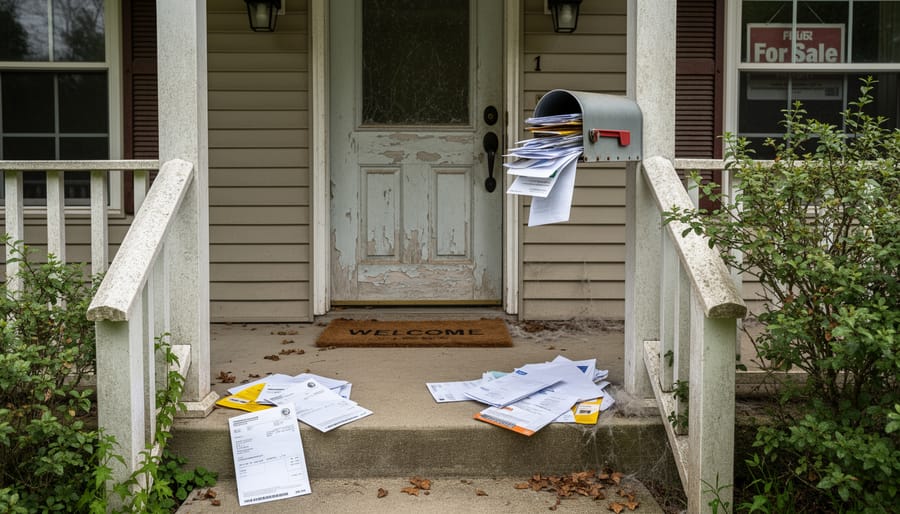
Ongoing Financial Hemorrhage
Every month your inherited property sits empty, it burns through capital like a satellite maintaining station-keeping maneuvers with no mission to justify the fuel cost. Unlike active space assets generating data or communications revenue, vacant properties consume resources while producing nothing, a financial black hole that most heirs drastically underestimate until they’ve watched thousands evaporate.
The baseline expenses hit with mechanical regularity regardless of whether anyone lives there. You’re looking at:
- Property taxes that continue accruing at full rates, often $3,000-$15,000 annually depending on location
- Homeowners insurance premiums that actually increase for vacant properties, sometimes 50-70% higher than occupied rates
- Basic utilities including water, electricity for security systems, and sometimes gas to prevent pipe freezing
- Lawn care and exterior maintenance to avoid code violations and neighborhood complaints
- Security monitoring or periodic check-ins to deter break-ins and vandalism
- Emergency repairs when HVAC systems fail, roofs leak, or pipes burst without anyone there to catch problems early
These aren’t optional expenses you can defer, they’re the minimum required to keep the property from becoming a liability lawsuit waiting to happen. A typical inherited home easily costs $800-$2,000 monthly just to keep the lights on and the grass cut, translating to $10,000-$24,000 annually with zero return. Six months of indecision doesn’t just cost you those direct expenses; it represents capital that could have been invested, debt that could have been paid down, or opportunities you couldn’t pursue because your inheritance was locked in an unproductive asset. The meter runs whether you’re ready to decide or not.
The Opportunity Cost Equation
Every dollar trapped in a vacant inherited property is a dollar unavailable for more productive ventures. NASA faces similar choices when allocating limited budgets between competing missions. Should funds go to Mars exploration or satellite maintenance? The agency calculates expected returns and opportunity costs to maximize scientific output per dollar spent.
Your inherited property creates the same dilemma. While it sits empty, you’re missing investment opportunities that could generate substantial returns. That capital could fund retirement accounts, reduce high-interest debt, or support business ventures with far greater upside than a deteriorating house.
Consider the math: if your inherited property could sell for $200,000 and that money earned just 7% annually in diversified investments, you’d generate $14,000 yearly. Meanwhile, the empty house costs you $8,000 annually in expenses. The real gap isn’t just the $8,000 you’re spending; it’s the $22,000 difference between what you’re losing and what you could be earning.
Space agencies understand that sitting on unused assets while better opportunities exist isn’t strategic patience. It’s strategic failure. The same principle applies to your inherited property.
Atmospheric Re-Entry: How Properties Deteriorate Without Occupancy
When satellites enter Earth’s atmosphere without controlled descent, they face catastrophic structural failure from heat and pressure. Vacant inherited properties undergo their own form of atmospheric re-entry, a progressive deterioration accelerated by the absence of human occupancy and regular maintenance that can’t be reversed without significant investment.
The damage begins within weeks. Without daily climate control, indoor temperatures and humidity swing wildly with outdoor conditions, causing wood to expand and contract at rates that stress joints and seals. Plumbing systems develop problems when water sits stagnant in pipes, encouraging corrosion and mineral buildup. In winter climates, even a brief heating failure can burst pipes and cause flooding that destroys flooring, drywall, and foundation integrity. These aren’t theoretical risks, they’re mathematical certainties over time.
Weather damage compounds exponentially in empty homes. A missing shingle becomes a roof leak. That leak saturates insulation and rots rafters. Meanwhile, clogged gutters overflow, directing water against foundations and into basements. Each system failure creates cascading problems that multiply repair costs geometrically, much like how small impacts on satellite solar panels degrade power generation until the entire mission fails.
Pests recognize vacant properties as prime real estate. Rodents chew through wiring, creating fire hazards. Termites consume structural wood undisturbed. Larger animals nest in attics and crawl spaces. The longer a property sits empty, the more entrenched these infestations become, eventually requiring professional remediation that costs thousands.
Regular occupancy provides constant surveillance and immediate intervention when problems emerge. Just as ground control monitors satellite health telemetry to reduce uncertainty about system failures, daily human presence catches deterioration early, a dripping faucet before it floods, a crack before it splits, an intruder before they squat. Without this active monitoring, properties degrade on an accelerated timeline that makes every month of vacancy disproportionately expensive.
Market Timing and Launch Windows: Why Speed Determines Success
The Property Market’s Orbital Mechanics
Real estate markets don’t move randomly, they follow cycles as predictable as planetary orbits, driven by economic forces, interest rates, and seasonal demand patterns. Just as mission planners calculate optimal launch windows based on orbital mechanics, property sellers who understand these cycles can time their decisions to capture maximum value.
The typical real estate cycle has four distinct phases: recovery (prices rising slowly, high inventory), expansion (accelerating prices, declining inventory), hyper-supply (peak prices, construction boom), and recession (falling prices, excess inventory). Each phase lasts 18 to 24 months on average, though external economic shocks can compress or extend them.
Inherited properties entering the market during expansion phases typically sell faster and command premium prices as buyer competition intensifies. Wait too long, and you risk entering hyper-supply when new construction floods the market, forcing you to compete on price. Miss the window entirely by holding through recession, and you’re facing potentially years of depressed values while still paying carrying costs.
The kicker: most sellers can’t precisely predict phase transitions, but they can observe leading indicators like inventory levels, days-on-market trends, and absorption rates. The smartest move? Act quickly during favorable conditions rather than gambling on perfect timing. Orbital mechanics teaches us that close enough to the ideal trajectory beats waiting for perfection, especially when every orbit costs fuel you can’t recover.
Missing Your Launch Window
Missing a favorable market window can trigger a domino effect of financial setbacks. When you hesitate during a seller’s market, high demand, low inventory, rising prices, you risk watching conditions deteriorate month by month. Interest rates might climb, cooling buyer enthusiasm. Inventory levels could surge as other sellers flood the market, diluting your competitive advantage. What was a 30-day sale opportunity in spring can become a 120-day slog by fall.
The aerospace industry understands that launch windows close for calculable reasons: planetary alignment, fuel efficiency, mission objectives. Real estate windows shut just as predictably. A six-month delay during peak conditions might mean accepting $20,000 less, carrying an extra $3,000 in holding costs, and facing stiffer negotiation from buyers who sense desperation. Each passing week compounds the disadvantage. Buyers perceive longer-listed properties as problem assets, lowering their opening offers accordingly. The market won’t wait for you to feel ready, it moves with or without your participation.
Liability and Risk: The Space Debris Problem on Earth
Just as orbital debris threatens active satellites with collision damage, an empty inherited property creates cascading liability exposures that grow more dangerous the longer it sits vacant. Space agencies track thousands of debris fragments because even a small piece traveling at 17,500 mph can destroy a multi-million dollar asset. Similarly, your vacant property attracts risks that can devastate your finances through lawsuits, fines, and catastrophic loss events.
The liability landscape for vacant properties includes serious threats:
- Personal injury claims if trespassers, delivery workers, or neighbors get hurt on your property
- Municipal code violations that trigger daily fines for unmaintained lawns, peeling paint, or structural hazards
- Insurance policy invalidation if your carrier discovers extended vacancy without proper notification
- Lawsuits from adjacent property owners claiming your neglect reduced their home values
- Criminal liability if squatters use the property for illegal activities
Squatters present a particularly complex challenge. Once someone establishes occupancy in your vacant property, removing them requires formal eviction proceedings that can take months and cost thousands in legal fees. Meanwhile, you remain liable for any injuries or damages that occur. Vandals cause an average of $3,000 in damage per incident, and vacant properties get targeted repeatedly. Broken windows invite weather damage that cascades into mold, structural rot, and repair bills exceeding $20,000.
Your homeowner’s insurance likely contains a vacancy clause that voids coverage after 30 to 60 days of non-occupancy. That means a fire, burst pipe, or storm damage could leave you personally responsible for six-figure losses. Some landlords selling fast discover their policies lapsed only after filing a claim. The solution requires either specialized vacant property insurance at triple the normal premium or decisive mission planning to secure or dispose of the asset before these risks materialize.
Mission Control: Strategic Options for Inherited Property

Quick Sale Trajectory
Selling an inherited property quickly functions like executing a fast-track spacecraft deployment, decisive action prevents cost overruns and captures optimal conditions. The immediate benefit is halting the financial drain: no more utilities, insurance, property taxes, or maintenance bleeding your inheritance. You convert an illiquid asset into deployable capital within weeks rather than months.
The rapid-sale process begins with a realistic property assessment. Get a professional evaluation, but don’t chase top-dollar pricing that extends market time. Properties priced at 95-97% of market value typically sell 60% faster than those priced at full retail. This slight discount pays for itself by eliminating months of carrying costs.
Cash buyers and investors offer the fastest trajectory, often closing within 7-14 days. While their offers run 10-20% below retail value, you skip repairs, staging costs, and extended holding expenses. Traditional sales through real estate agents take 30-90 days but usually net higher proceeds after commissions.
The mathematics favor speed: a property costing $800 monthly to maintain loses $7,200 during a nine-month listing. Quick execution, even at a modest discount, often yields superior net proceeds while freeing capital for strategic redeployment.
Rental Mission Planning
Converting an inherited property into a rental parallels deploying a satellite into productive orbit, it requires upfront investment but generates ongoing returns. This trajectory works best when you can commit to active property management or afford professional oversight.
Calculate your mission parameters first. Subtract mortgage payments, property taxes, insurance, maintenance reserves, and management fees (typically 8-10% of monthly rent) from projected rental income. If the net cash flow stays positive and you’re comfortable with landlord responsibilities, rental deployment makes financial sense.
Speed still matters here. Every month the property sits empty waiting for tenants represents negative cash flow. Screen tenants thoroughly but efficiently, rigorous background checks prevent costly evictions later. Consider hiring a property management company if you live far away or lack experience; their fees often prove cheaper than amateur mistakes.
The rental mission offers tax advantages through depreciation deductions and builds equity over time. However, it converts a liquid asset into an illiquid one, tying up capital you might deploy elsewhere. Run the numbers against alternative investments before committing to this longer orbital period.
Strategic Holding Protocol
Sometimes maintaining an inherited property makes strategic sense, if you’re planning to relocate within six months, waiting for a child to finish school, or timing a major market upswing based on confirmed development plans. But even temporary holding requires active management, not passive waiting. Install smart home monitoring systems to catch leaks or break-ins immediately. Redirect mail, maintain minimum climate control to prevent mold, and arrange quarterly inspections. Pay someone to mow lawns and clear debris, an unkempt property broadcasts vacancy to opportunistic criminals. Set a firm decision deadline, just as space agencies establish mission review gates. Drifting into indefinite holding converts a calculated pause into the expensive deterioration we’ve outlined. Strategic holding means maintaining property condition while actively planning your next move, not simply postponing difficult decisions.
Just as mission controllers can’t afford to hesitate during a critical spacecraft maneuver, property owners facing inheritance decisions must act with similar decisiveness. Every day an inherited property sits empty represents fuel burning without propulsion, resources depleting without return.
Throughout this exploration, we’ve seen how the principles governing orbital mechanics apply surprisingly well to real estate. Degradation accelerates without intervention. Costs compound exponentially. Optimal launch windows close. The difference between a successful mission and a costly failure often comes down to executing decisions when they matter most, not when they feel most comfortable.
The data is clear: swift action minimizes financial drain, preserves property value, and captures market opportunities that delay erases. Whether you choose a quick sale trajectory, rental mission planning, or strategic holding protocol, the key is choosing and moving forward.
We invite you to share your inherited property experiences in our community forums. Connect with others navigating similar challenges, exchange strategies, and learn from real-world mission reports. Your insights could help another reader achieve mission success.
Subscribe to our newsletter for more practical guidance where space economics meets everyday decisions.