

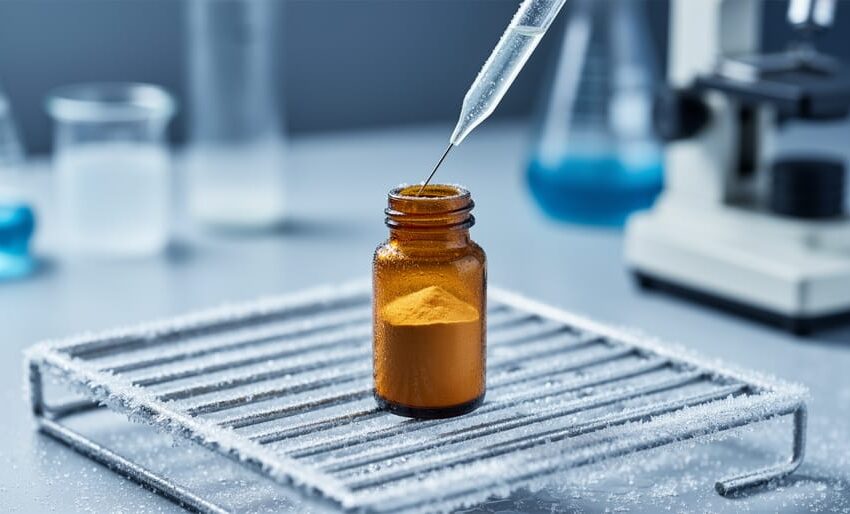
To store and reconstitute Kylo GHK-Cu copper peptides, keep the lyophilized powder cold and dry, add sterile solvent slowly down the vial wall, swirl gently until clear, then refrigerate the solution and use it within the window your supplier specifies. The whole job takes about 15 minutes of hands-on time and sits at beginner-to-intermediate difficulty. The one real prerequisite is a clean workspace and the supplier’s datasheet within arm’s reach.
Why the fuss? GHK-Cu is a small tripeptide bound to a copper ion, and both halves are sensitive. Heat, moisture, light, and rough agitation can degrade it before you ever run an experiment. Good sample handling works the same way for a gram of lunar regolith as it does for a milligram of peptide: protect the material, document what you did, and don’t improvise.
Specifics like solvent choice, concentration, and shelf life vary by product, so defer to the datasheet that ships with your vial. If you’re sourcing material, the listing for Kylo GHK-Cu is a useful reference for what a supplier’s documentation should cover.
Below, we walk through tools, safety checks, each reconstitution step, and how to verify your result. Stuck on a step? Our community forums are full of researchers comparing notes, and the newsletter delivers new lab-handling guides straight to your inbox.
Why GHK-Cu Is Fussy: Understanding the Copper-Peptide Complex
GHK-Cu is a tripeptide, meaning a tiny chain of just three amino acids: glycine, histidine and lysine. Bound to that chain is a copper ion, and the pairing is called a complex. Think of the peptide as a small cradle holding the copper in place. Your handling routine exists mainly to keep that cradle intact.
The trouble is that the bond is not unbreakable. Several everyday factors can wear it down or damage the peptide itself.
– Moisture: Water can encourage slow breakdown of the peptide, which is why the dry powder form is so much more forgiving than a solution.
– Heat: Warmth speeds up almost every chemical reaction, including the unwanted ones.
– Light: Prolonged exposure can drive changes in the molecule, so dark storage is standard practice.
– Oxidation: Contact with oxygen can chemically alter parts of the peptide, and copper itself can influence these reactions.
– pH shifts: pH is a measure of acidity. Drifting too far from the range the complex prefers can loosen copper’s grip on the peptide.
– Chelating agents: These are molecules, such as EDTA, that grab metal ions tightly. If one is in your diluent or on your tools, it can pull copper right out of the complex.
Here is a handy cue. The intact complex typically looks blue in solution. A noticeable colour change can hint that something has shifted, though it is only a visual clue and not proof of quality.
Exact stability limits vary by supplier and formulation, so treat the datasheet as your authority.
Tools and Materials to Have Ready Before You Open the Vial
Before you break the seal on a vial, get everything laid out within arm’s reach. A rushed hunt for a pipette tip mid-procedure is how contamination and mistakes creep in. Think of it as a pre-launch checklist: nothing exotic, but every item earns its place.
- The sealed vial and its paperwork, because the certificate of analysis and datasheet set your storage and solvent rules.
- A sterile diluent such as sterile water or a compatible buffer, chosen according to supplier guidance.
- Sterile, low-retention pipette tips, so little peptide clings to the plastic.
- Alcohol swabs, to sanitize the vial stopper before every puncture.
- A calibrated balance or sterile syringes, for measuring volumes accurately.
- Low-protein-binding tubes for aliquots, which keep peptide from sticking to the walls.
- Labels and a marker that survives cold, for date, concentration, and diluent.
- A lab fridge and freezer with reliable temperature monitoring, for both powder and solution.
- A sealed desiccant container, to keep stored powder dry.
Equally important is what to leave off the bench. Skip metal spatulas, needles you plan to leave in contact with the solution, and any buffer containing strong chelators such as EDTA. Chelators grab copper ions, and metal tools can introduce stray ions. Either one can disturb the copper complex that gives GHK-Cu its character.
Check that your diluent and consumables are in date and still sealed. If the supplier’s instructions name a specific solvent, follow them over any general suggestion here.
Safety Warnings and When to Stop and Reassess
Before you open a vial, set up the basics. Wear nitrile gloves, eye protection and a lab coat, and work on a clean, wiped-down bench. GHK-Cu is sold for research use only, so follow your institution’s protocols and read the supplier’s safety data sheet first. That sheet tells you what the manufacturer expects, and it overrides anything here. This article is general guidance, not medical advice.
Contamination is the quiet saboteur of peptide work. Use sterile tips, swab the stopper, and keep the vial closed whenever you aren’t drawing from it. Treat the diluent as part of the experiment too, since water quality can quietly shift the outcome. The same discipline that mission teams apply to avoid contamination of a collected sample applies at your bench.
Stop and reassess if you see any of these:
– A damaged or loose seal on arrival
– Unexpected discolouration of the powder or solution
– Visible particulates in the vial
– Cloudiness after mixing
– Missing paperwork or a certificate of analysis
– Any doubt about the vial’s history or storage
When in doubt, set the vial aside and contact the supplier.
Storing Lyophilized GHK-Cu: Keeping the Powder Stable
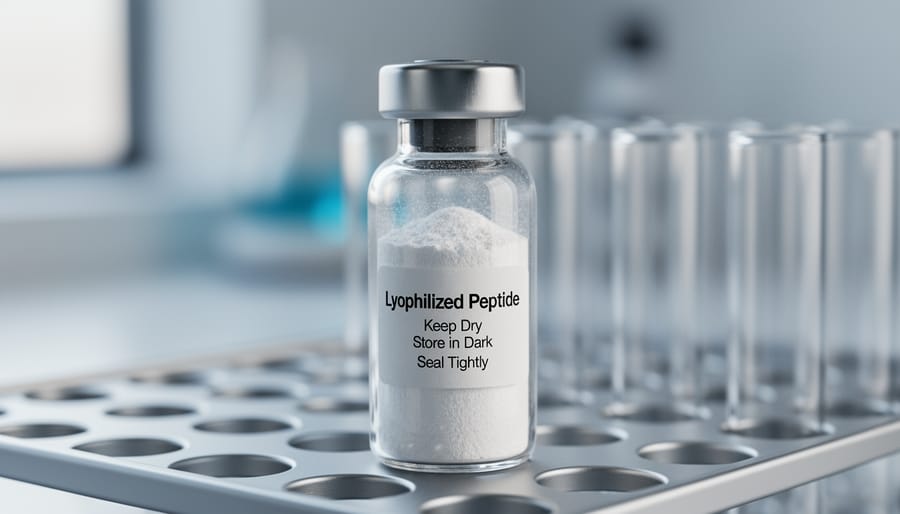
Lyophilized GHK-Cu is at its most stable when it stays dry, so storage of the unopened powder is really about keeping out four things: warmth, light, moisture, and air. Start with temperature. Many suppliers specify refrigeration, and others call for a freezer, so follow the datasheet or certificate of analysis that came with your lot rather than relying on a general rule. The same goes for shelf life, since that figure varies between suppliers and formulations.
Keep the vial tightly sealed in its original packaging until you need it. Light can nudge a copper-peptide complex toward degradation, so store it in the dark, such as in a closed box inside the fridge or freezer. A small sealed container with desiccant adds a second layer of protection against humidity, which is the quiet enemy of any freeze-dried powder.
Here’s the step people most often skip: let a cold vial warm to room temperature before you open it. Pull it from the fridge or freezer and leave it sealed on the bench until it no longer feels cool. Open it too early and moisture from the air condenses on the powder, which can start degrading it before you’ve added any solvent. Think of it like a spacecraft part leaving a cold storage bay: you let it acclimate first.
Finally, keep a record. Log the receipt date and lot number for every vial, along with where it’s stored. If you ever need to troubleshoot an odd result or contact the supplier, that paper trail saves a lot of guesswork.
How to Reconstitute GHK-Cu Step by Step
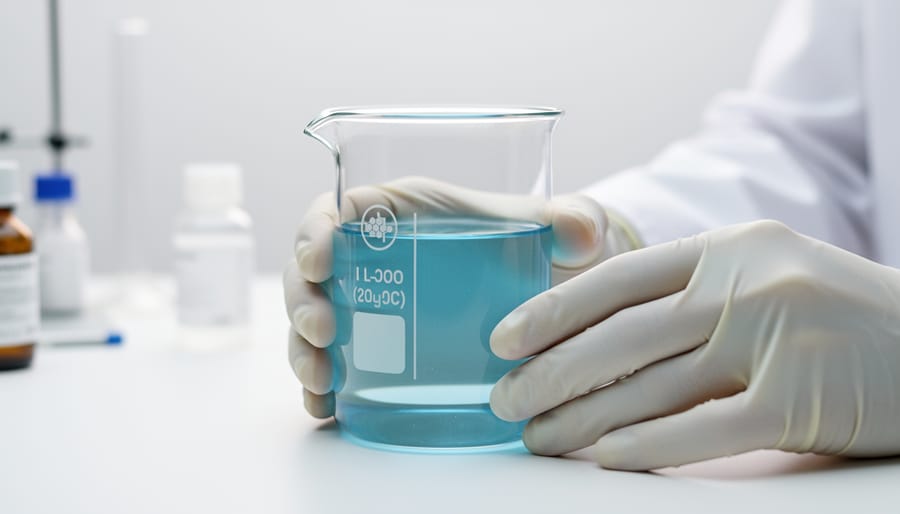
Reconstitution is the most hands-on moment in the whole workflow, so work through it in order and don’t skip ahead. Think of it like a spacecraft pre-launch checklist: each step exists because someone, somewhere, got burned without it.
- Confirm the vial and paperwork. Match the lot number on the label to the certificate of analysis, and check that the seal is intact and the cake looks as the datasheet describes.
- Warm the vial to room temperature. Leave it sealed on the bench until no condensation remains on the glass.
- Sanitize the stopper. Wipe it with an alcohol swab and let it air-dry fully before piercing.
- Prepare your diluent. Use the sterile solvent the supplier recommends, brought to room temperature.
- Calculate the target concentration. Divide the labelled peptide mass by your chosen final concentration to get the solvent volume, and double-check the arithmetic.
- Add the solvent slowly. Angle the needle or pipette tip so the liquid runs down the inner wall of the vial rather than hitting the powder directly.
- Swirl gently. Roll or swirl the vial in slow circles. Never shake it.
- Wait for full dissolution. Give it a few minutes and swirl again if needed.
- Inspect the result. Hold it against a white background, looking for a clear solution without particulates.
- Label immediately. Record the date, concentration, diluent, and your initials.
Why does gentle mixing matter? Vigorous shaking creates foam and air-liquid interfaces, and peptides can partially unfold or aggregate at those surfaces. Bubbles also expose the sample to more dissolved oxygen, which is unhelpful for a copper-bearing complex. Patience costs you five minutes. Foaming can cost you the sample.
Diluent choice deserves the same care. Sterile water is a common default, but some suppliers specify a particular buffer. The reason is pH: GHK-Cu holds onto its copper best within a moderate pH range, and a solvent that is too acidic or too basic can weaken that grip. Avoid any buffer containing strong chelators, such as EDTA, because they can strip copper from the peptide. If the supplier names a diluent, use it. If they don’t, ask before improvising.
When you inspect the finished solution, an intact complex typically looks blue, and the solution should be clear. Cloudiness, particles, or an unexpected colour shift are your cue to stop and reassess, as covered in the safety section earlier.
Storing the Solution: Aliquots, Temperature and Shelf Life
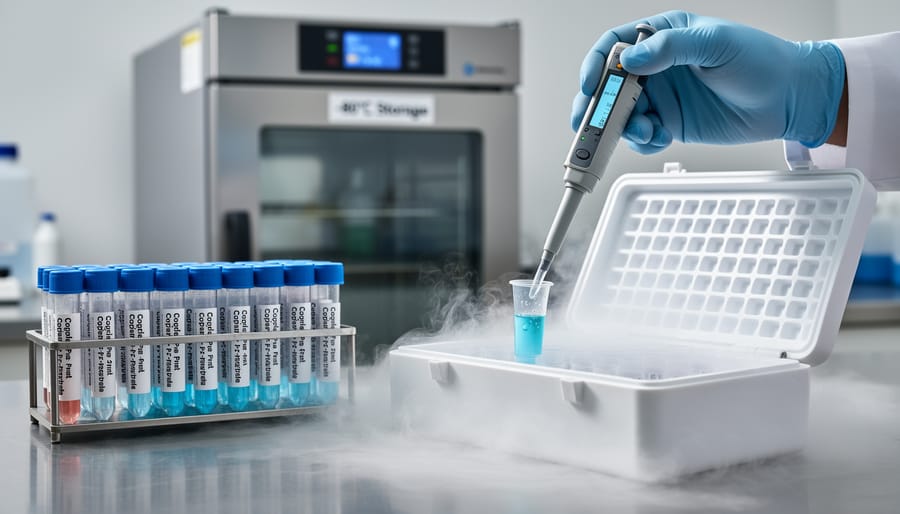
Once GHK-Cu is in solution, the clock starts. Reconstituted peptides are far less stable than the freeze-dried powder, so treat the liquid as the fragile form and plan your storage before you ever add the diluent.
Start by dividing the stock into single-use aliquots. Use low-binding tubes, which reduce the amount of peptide that sticks to the plastic walls, and size each aliquot to what one experiment actually needs. Label every tube with the date, concentration, diluent, and lot number. That small habit saves a lot of confusion later.
Next, choose your temperature based on the supplier’s datasheet. Some suppliers recommend refrigeration for short-term use, while others suggest freezing aliquots for longer holds. Follow their guidance rather than a rule of thumb from a forum post. The reasons for caution are simple: the right temperature depends on your diluent, pH, and concentration.
Avoid repeated freeze-thaw cycles. Each round can stress the peptide and encourage degradation, which is exactly why single-use aliquots matter. Thaw one tube, use it, and discard what’s left over rather than returning it to the freezer.
Keep light exposure low by storing tubes in a box or a dark container. Watch for changes in colour, cloudiness, or particulates before each use, and discard anything that looks off.
Finally, respect the expiry window. How long a reconstituted solution stays usable should come from the supplier or published data, not from assumptions. When the recommended window ends, discard the solution.
Checking Your Work and What to Do Next
Once the vial is mixed and labelled, the job isn’t finished. A few quick checks tell you whether the solution is fit to use, and good records make every later result easier to trust. Treat this step with the same lab precision you’d bring to the dissolving itself.
- Appearance: the solution should be clear, typically blue, with no particulates, haze or floating fibres.
- Labelling: confirm the label shows date, concentration, diluent, lot number and your initials.
- Records: log the vial’s storage history, the reconstitution steps, and any deviation from the plan.
- Supplier contact triggers: reach out if the colour is unexpected, the solution stays cloudy, or the paperwork doesn’t match the vial.
- Optional confirmation: a certificate of analysis, or your own spectrophotometry or HPLC check if your lab has the equipment.
You don’t need advanced instruments for routine work. Most labs rely on the visual check, careful notes and the supplier’s certificate of analysis. If you do have a spectrophotometer or HPLC system, they can add confidence for sensitive experiments, but they aren’t a universal requirement.
When something looks off, write it down before you do anything else, then ask the supplier. A clear record makes that conversation quick and productive.
Have a handling tip that saved a sample, or a question this guide didn’t answer? Bring it to our community forums, where fellow researchers swap lab-craft insights. And subscribe to the newsletter for more practical science explainers delivered to your inbox.
Common Questions About Handling GHK-Cu
A few questions come up again and again once the vial is on the bench. Here are short answers, with the usual caveat: your supplier’s datasheet always has the final word.
Can I shake the vial to speed up dissolving?
No. Shaking can foam the solution and stress the peptide, so swirl gently and give it time instead.
What diluent should I use?
Use whichever sterile diluent the supplier specifies, often sterile water or a compatible buffer. Avoid anything containing strong chelators, since they can pull copper out of the complex.
Why did my solution change colour?
An intact complex typically looks blue, so a shift toward another colour, or cloudiness, can signal degradation or contamination. Stop and reassess, and contact the supplier if you’re unsure.
Can I refreeze leftover solution?
It’s best not to. Repeated freeze-thaw cycles can damage peptides, which is why single-use aliquots are the safer habit.
How long does reconstituted GHK-Cu last?
It’s far less stable than the dry powder, and the exact window depends on the diluent and storage conditions. Follow the supplier’s guidance or published data rather than assumptions.
Think of these answers as a quick-reference card, the lab equivalent of a pre-flight checklist taped inside a cabinet door. If your situation doesn’t match any of them, the safest move is to pause and check the documentation that came with your vial. Have a handling question we haven’t covered? Bring it to the community forums, where other readers share what’s worked in their own labs.
A good mission starts long before launch. It starts with the unglamorous work of keeping sensitive samples clean, cold, and accounted for. GHK-Cu asks for the same discipline.
Keep the lyophilized powder cold, dry, dark, and sealed. Let the vial warm before you open it, add your sterile diluent slowly, and swirl rather than shake. Split the finished solution into single-use aliquots, label everything, and follow your supplier’s datasheet over any general rule of thumb. If something looks off, stop and reassess instead of pushing ahead.
None of this is dramatic, and that’s the point. Precision in small steps is what makes results you can trust, whether you’re protecting a peptide in a fridge or a sample bound for orbit.
Have a handling tip or a question? Bring it to our community forums, and subscribe to the newsletter for more lab-craft and science explainers.